New Feature
Updates
Introducing Order Reports: Make Informed Order Decisions
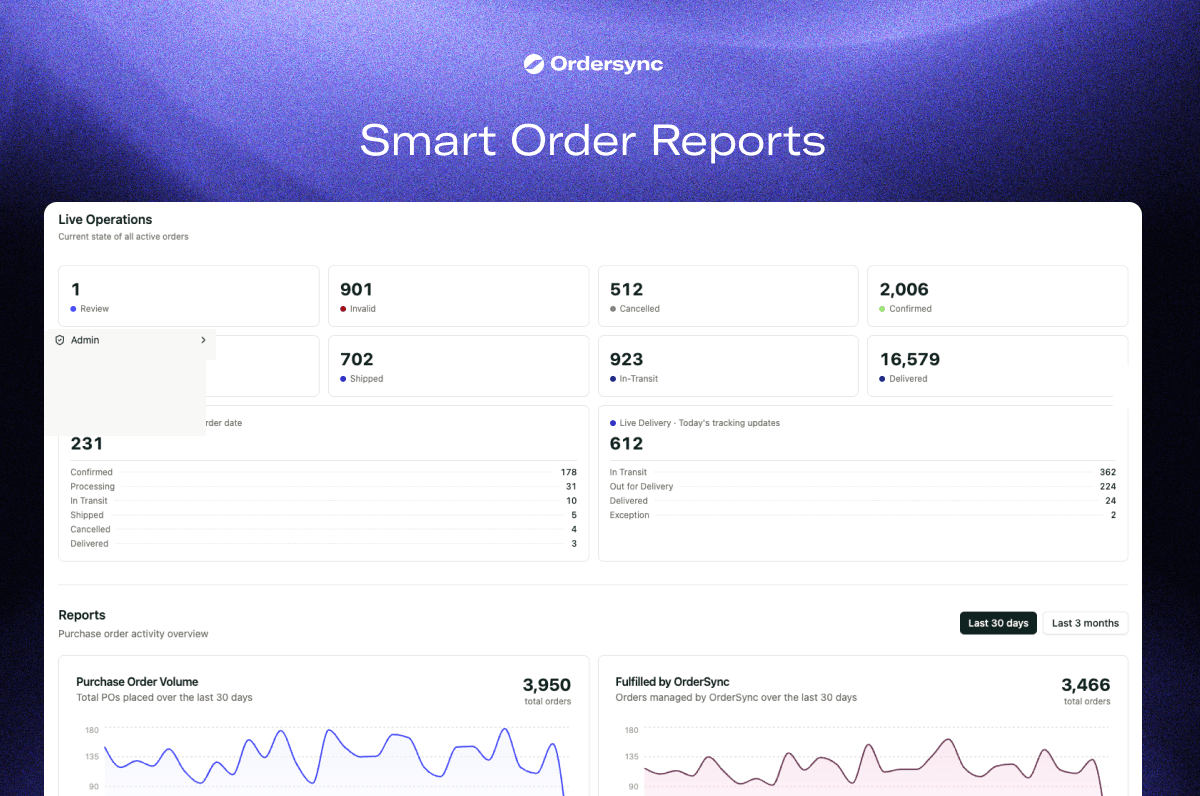
Special orders and dropship are the backbone of modern golf retail. But without real-time visibility into every purchase order, you're flying blind — and your customers are paying the price.
Think about the last time a customer called asking about their Titleist Pro V1x order. You checked your system, saw it was "Processing," and told them it should be a few more days. Two weeks later they were back — frustrated, ready to cancel. The order had been sitting delayed with the supplier the entire time, and nobody knew.
This isn't a staffing problem or a supplier problem. It's a visibility problem. And for golf retailers running significant special order and dropship volume, it's quietly costing you in customer trust, staff time, and margin.
3+ wks Average delay threshold most retailers only catch by accident
70%Avg on-time delivery rate across top golf suppliers
~30%Of active POs that need proactive intervention at any given time
The special order problem no one talks about
Special orders are a high-trust transaction. A golfer walks into your shop, picks out a specific shaft flex, loft, and custom grip color — often spending $300–$700+ — and hands you their money before the product even exists in your inventory. They're trusting you completely.
The moment that PO leaves your system, most retailers lose meaningful visibility into it. It becomes a black box. You know when you placed it. You might know roughly when it should arrive. But you don't know if it's been confirmed by the supplier, whether it's delayed, or where in the fulfillment chain it sits right now.
"The problem isn't that things go wrong — that's inevitable in any supply chain. The problem is finding out too late to do anything about it."
Multiply that uncertainty across a few hundred open purchase orders at any moment, and you have a staff that's constantly firefighting: calling suppliers, manually checking tracking numbers, and apologetically calling customers to deliver news they should have delivered days ago.
What real-time PO visibility actually looks like
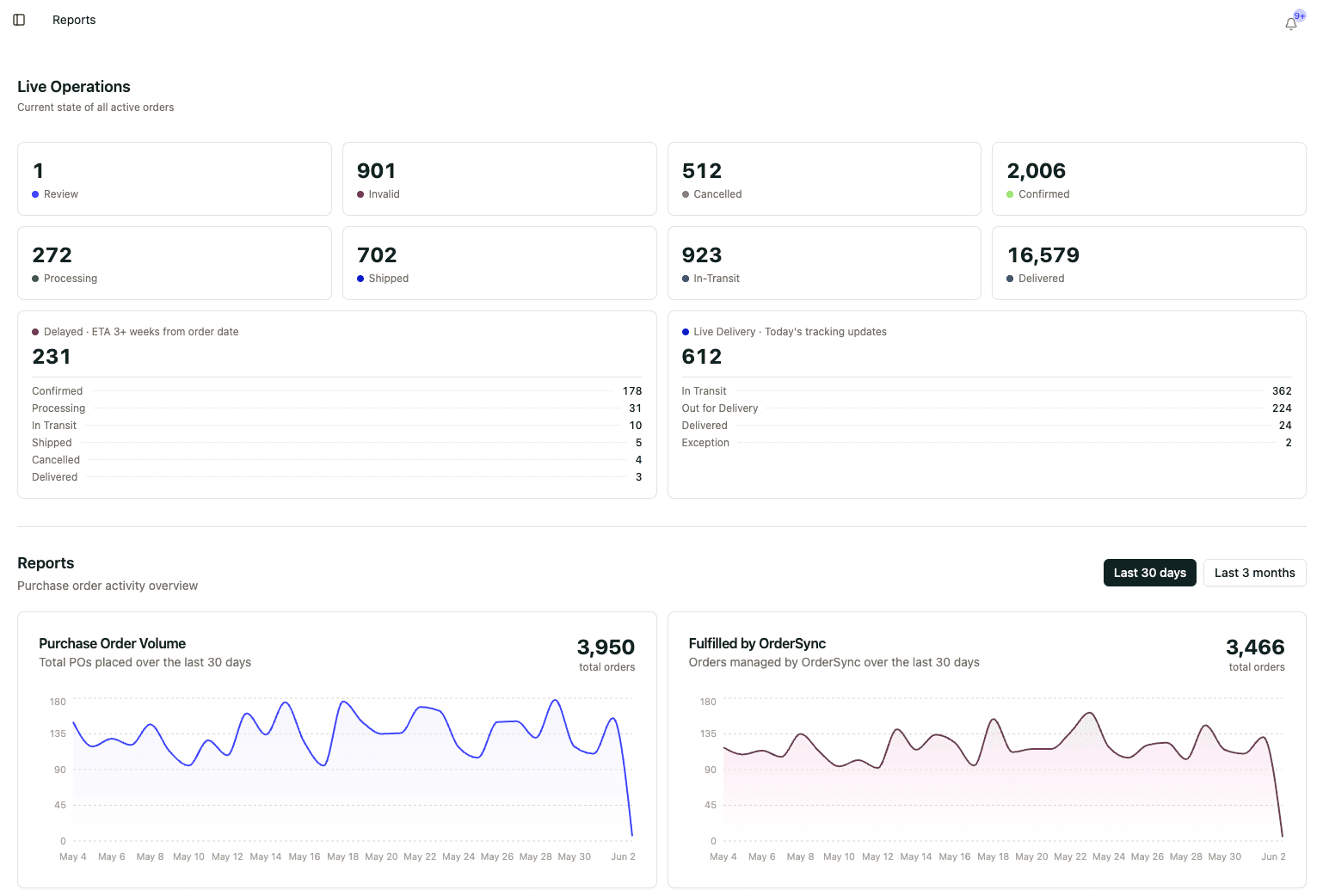
Imagine opening your morning dashboard and seeing — at a glance — exactly where every active order stands.
Not just totals — but a breakdown of which orders are delayed, how long they've been delayed, where in the workflow they're stuck (confirmed but not shipped? shipped but stalled in transit?), and which are scheduled for delivery today.
This is the difference between reactive retail and proactive retail. When you can see that 231 orders are flagged as delayed — and that 178 of them are confirmed but not yet moving — you can act. Call the supplier. Reach out to the customer before they call you. Offer to swap to a similar product in stock. Manage the situation instead of just absorbing it.
Dropship amplifies everything — the good and the bad
Dropship is a powerful business model for golf retail. You can offer the full assortment of Callaway, TaylorMade, Titleist, PING, and Mizuno without carrying every SKU in the back. Your showroom becomes your entire catalog.
But dropship introduces a complication: the fulfillment is entirely out of your hands. The supplier ships directly to your customer, often with your branding, but the tracking, communication, and exception management still lands on your team. If a Ping G440 driver ships to the wrong address, or arrives at a distribution center with no movement for five days, you're the one the customer calls.
With full PO visibility, every dropship order is monitored through the same lens as your in-house inventory. You see supplier confirmation, shipment creation, carrier pickup, in-transit status, out for delivery, and exceptions — all in one place, without calling anyone.
Supplier performance: the data you didn't know you needed
Here's a question most golf retailers can't answer with confidence: which of your suppliers actually delivers on time?
Not what they promise on their sell sheets — but actual, historical, measured on-time delivery rate across all your purchase orders. And how does that compare to their average lead time?
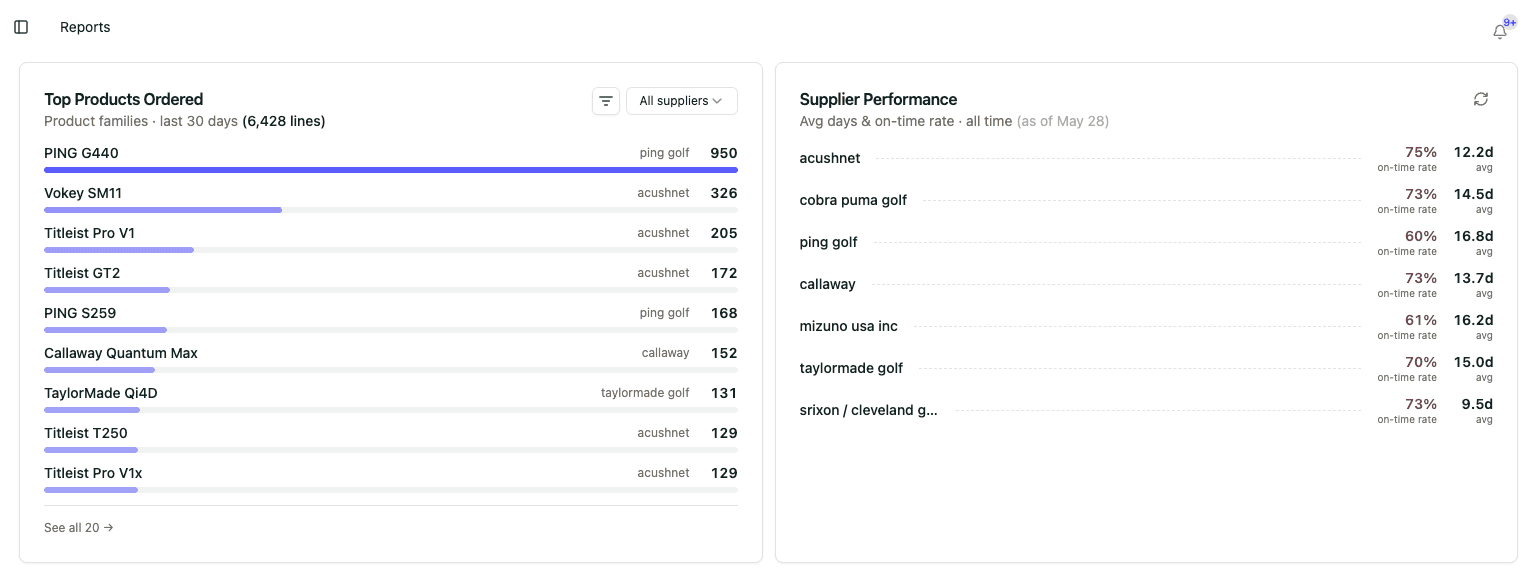
When you have that data, buying decisions change. You learn that one vendor has a 60% on-time rate with a 16.8-day average — meaning nearly half of customer promises you make based on their quoted lead times will be wrong. You learn which vendors are most reliable for rush situations. You start having very different conversations at buying shows.
You also get ammunition for customer conversations. "We route Titleist special orders through Acushnet directly — they run about 75% on-time and average 12 days, which is best in class for this type of custom order." That kind of informed, specific communication builds trust in a way that vague "should be about two weeks" answers never can.
The volume picture: what's actually selling
Real PO visibility isn't just about order status — it's about understanding your business at a product level. When you can see that PING G440 generated 950 PO lines in the last 30 days, followed by Vokey SM11 at 326 and Titleist Pro V1x at 205, you have an honest, unfiltered view of demand.
This matters for floor planning, buying, staff training, and supplier negotiations. If a product family is consistently moving high volume through special orders, that's a signal it deserves floor space or stocking consideration. If it's a persistent dropship item with variable lead times, you can build that nuance into how your staff sets expectations.
The geography of demand
One often-overlooked dimension of PO data is the geography question: where are your orders actually going? For retailers with dropship volume, this matters more than it seems.
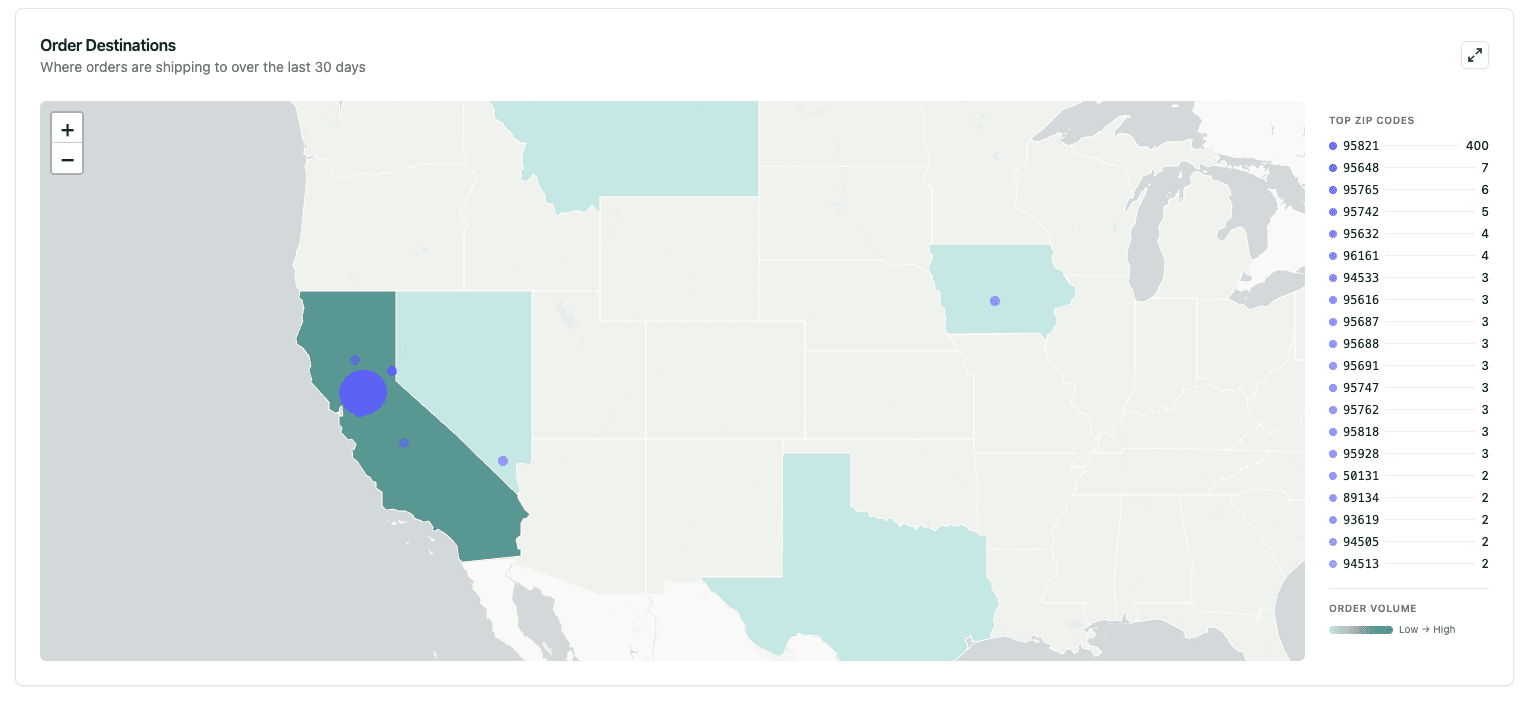
Seeing order destinations plotted on a map — with concentration by zip code — surfaces things like regional product preferences, which suppliers are most efficient shipping to your core customer base, and whether there are dense pockets of customer activity that might warrant a new marketing approach or delivery partnership.
It also helps with carrier decisions. If 400 orders in the last 30 days are landing in the same zip code cluster, that's leverage in a carrier conversation.
What this means for your team
The downstream effect of visibility isn't just operational — it's cultural. When your team has access to real data about order status, supplier performance, and delivery tracking, they stop guessing. They stop spending the first 20 minutes of every shift checking emails and calling reps for updates. They start conversations with customers from a position of knowledge instead of uncertainty.
✓Fewer inbound status calls. Customers who get proactive updates don't need to call. One-touch outreach when an order is delayed cuts inquiry volume significantly.
✓Faster exception handling. A delayed order caught at day two is recoverable. The same order caught at day fourteen often isn't — or costs you margin to fix.
✓Smarter buying conversations. Data-backed supplier performance metrics put you in a better position at buying shows and during terms negotiations.
✓Stronger customer relationships. The retailer who calls you before you have to call them has earned a repeat customer. Visibility is what makes that call possible.
✓Cleaner revenue reporting. When you can see order volume trends, delivery rates, and product mix in one place, financial planning becomes far less guesswork.
"The retailers who will win the next decade aren't just the ones with the best product selection — they're the ones whose operations are invisible to the customer. Everything just works."
The golf equipment market is not getting simpler. Custom fitting demand is up. Direct-to-consumer pressure from brands is constant. Customer expectations around communication and speed are shaped by Amazon, not by legacy golf retail norms. The retailers who survive and grow will be the ones who have built operational foundations that can handle complexity without heroics.
Full PO visibility isn't a luxury feature. It's the foundation of a modern retail operation — and increasingly, the table stakes for earning a customer's repeat business in a category where trust and service are still the differentiators that matter most.
Contact us for a demo today: sales@ordersync.co
